.png)
For many electronics manufacturers, rising costs are no longer driven by higher production volumes. Even when output remains stable, bill of materials (BOM) costs continues to creep upward — and solder paste is increasingly part of that pressure.
What makes this particularly frustrating is that nothing appears to have changed on the production line. The same solder paste is being used, in the same way, with the same process settings, yet prices move upward quarter after quarter.
This often shows up internally as:
- Procurement teams questioning why consumables cost more than last quarter.
- Forecasts becoming harder to lock in as pricing changes more frequently.
- Repeated “same paste, new price” conversations with suppliers.
Unlike components that can sometimes be redesigned or dual-sourced, solder paste is often treated as a fixed, dependable input.
The reality is simple: solder paste has stopped behaving like a stable cost line item.
Why Silver Content Is the Cost Driver
In lead-free SAC alloys, silver is one of the most expensive — and most price-volatile — metals in the formulation. While it represents only a small percentage of the alloy by weight, its contribution to material cost is outsized, particularly at production scale.
What’s easy to overlook is how small percentage differences translate into actual cost exposure when applied across:
- High-volume SMT production.
- Continuous consumable usage.
- Long-term supply agreements.
High-silver solder pastes, such as traditional SAC305 formulations, are therefore more exposed to precious-metal price movements. When silver prices rise, these pastes tend to amplify that volatility rather than buffer against it.
The result is a consumable that behaves less like a stable process input and more like a variable cost tied directly to the metals market, shifting quarter to quarter without any change in formulation, performance, or usage.
This is why silver content matters more than it used to. Understanding how it influences solder paste cost is the first step toward assessing whether a different alloy balance could deliver greater cost stability — without compromising manufacturing requirements.
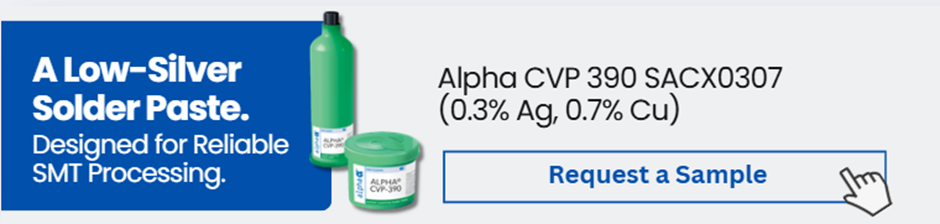
A Practical Low-Silver Alternative Engineers Are Evaluating: Alpha CVP 390 SACX0307
As manufacturers reassess the role of silver content in solder paste selection, attention is increasingly shifting toward low-silver SAC alloys designed to balance cost control with process stability.
One option engineers are actively evaluating is Alpha CVP-390 SACX0307, developed by Alpha Assembly Solutions. It is not intended to replace SAC305 across all applications, nor to claim a “new and better” formulation. Rather, it offers a proven alternative for manufacturers navigating today’s cost pressures, where precious-metal price volatility is a growing operational concern.
At the alloy level, CVP 390 SACX0307 significantly reduces silver content compared with traditional SAC305. This lower silver percentage directly reduces sensitivity to silver price fluctuations, helping to stabilise solder paste costs over time, particularly in volume production environments were small material differences scale quickly.
From a manufacturing perspective, CVP-390 SACX0307 is engineered to address the key concerns engineers typically have when evaluating lower-silver alloys:
- Predictable printing behaviour
- Stable reflow performance.
- Fine-feature capability suitable for modern SMT assemblies
The focus is not on pushing performance boundaries, but on maintaining consistent, reliable processing while reducing unnecessary exposure to volatile precious-metal pricing.
For engineers and manufacturers navigating rising consumable costs, CVP-390 SACX0307 represents a practical low-silver option worth evaluating under real production conditions.
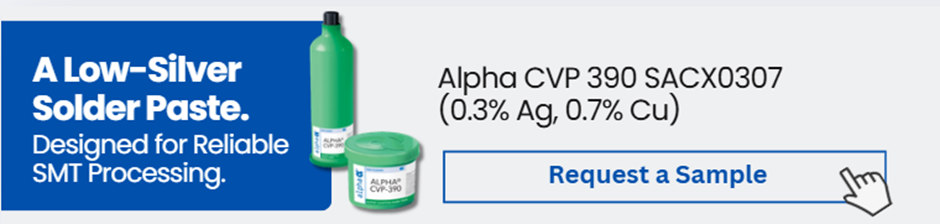
Active Components currently has a limited number of evaluation samples available for customers in New Zealand and Australia, allowing teams to assess suitability on their own production lines with no obligation.
What Do the Numbers Mean in SAC305 and SACX0307?
Solder pastes names like SAC305 or SAC0307 are often treated as product codes, but they describe the alloy composition.
What does “SAC” mean?
“SAC” refers to the three primary metals in the alloy:
- S = Tin (Sn)
- A = Silver (Ag)
- C = Copper (Cu)
For example, SAC305 consists of:
- 3.0% Silver (Ag)
- 0.5% Copper (Cu)
- Balance: Tin (Sn)
This relatively high silver content is one reason SAC305 has long been valued for its mechanical reliability and established process window. However, it also means the alloy’s cost is highly sensitive to fluctuations in silver pricing.
Using the same naming logic, SACX0307 contains:
- 0.3% Silver (Ag)
- 0.7% Copper (Cu)
- Balance: Tin (Sn)
Also, the critical difference is the “X.”
In SACX alloys, the “X” indicates a micro-alloyed formulation. This means that, in addition to tin, silver, and copper, small, controlled amounts of other elements are added to help compensate for the reduced silver content. The purpose of micro-alloying is not cost reduction alone, but to support mechanical stability, wetting behaviour, and process robustness that would otherwise rely on higher silver levels.
Compared with SAC305, SACX0307 represents a substantial reduction in silver content, while using alloy design to maintain reliable SMT processing characteristics. From a cost perspective, this significantly reduces exposure to silver price volatility—an increasingly important consideration in high-volume and cost-sensitive manufacturing environments.
Performance vs. Silver Content
A common assumption in electronics manufacturing is that reducing silver content inevitably compromises solder joint performance. While silver does contribute to mechanical strength and thermal fatigue resistance, real-world reliability is shaped by a wider set of factors, including alloy balance, joint geometry, thermal design, and process control.
High-silver alloys such as SAC305 continue to play an important role in applications exposed to extreme operating conditions or governed by strict qualification requirements. In sectors such as medical, military, and certain automotive or industrial environments, established performance history and conservative design margins often justify the continued use of higher-silver formulations.
However, many electronics assemblies do not operate under these extremes. In consumer electronics, general commercial products, and a wide range of industrial control applications, operating temperatures are relatively stable and mechanical loading is moderate. In these environments, manufacturing consistency and process repeatability often have a greater influence on performance outcomes than silver percentage alone.
Advances in alloy formulation have enabled modern low-silver solder pastes to deliver reliable wetting behaviour, controlled voiding, and stable microstructures without relying on high precious-metal content. By optimising alloy balance and flux chemistry, these materials can support predictable assembly performance while reducing exposure to silver price volatility.
From a practical perspective, silver content should not be viewed as a simple measure of quality. It is one design variable among many. Increasingly, manufacturers apply a fit-for-application approach — reserving high-silver alloys where their benefits are clearly required and confidently evaluating low-silver alternatives where performance has already been validated through production use.
Other Performance Questions Engineers Always Ask
Any change in alloy composition raises legitimate questions — and experienced engineers are right to be cautious. On the production line, process stability matters far more than theoretical cost savings, which is why low-silver solder pastes are always evaluated carefully before adoption.
Some of the most frequent questions include:
How does it behave in terms of voiding?
Voiding behaviour is influenced by more than just silver content. Flux chemistry, reflow profile, component design, and process control all play a role. Modern low-silver, micro-alloyed formulations are designed to support controlled wetting and consistent voiding behaviour when processed within appropriate parameters — but this must be verified on the line.
Is print consistency affected?
Print performance is critical for repeatability and yield. Any alternative alloy must deliver reliable stencil release and consistent deposit formation across multiple print cycles. This is often one of the first areas engineers assess during evaluation.
What about pin testing and electrical reliability?
Pin test performance remains a key consideration, particularly for fine-pitch and high-density assemblies. Here, formulation design and micro-alloying are intended to support consistent electrical results comparable to traditional SAC alloys.
Will it work with our existing reflow profile?
Many low-silver SAC alloys are designed to operate within familiar SAC process windows. That said, minor profile optimisation is often part of a responsible trial — not because the alloy is unstable, but because validation matters.
Testing under real production conditions allows engineers to confirm compatibility, validate performance, and assess cost impact without committing to a full material change.
View the CVP-390 datasheet.
Next Step: Request an Evaluation Sample from Active Components
Silver pricing remains volatile, and solder paste costs are becoming a more visible factor in production planning. Evaluating a low-silver alternative now gives engineering and procurement teams the flexibility to make informed decisions — before cost pressures force reactive changes.
Active Components currently has a limited number of low-silver solder paste evaluation samples available for customers in New Zealand and Australia. Testing under your own production conditions allows you to assess suitability without commitment.