.png)
Multilayer ceramic capacitors (MLCCs) are among the most widely used passive components in modern electronic design. From power management circuits to signal filtering and decoupling applications, MLCCs play a critical role in ensuring stability, efficiency, and long-term reliability across a wide range of electronic systems.
As devices continue to become smaller, faster, and more power-efficient, the need for compact, high-performance capacitors has increased significantly. MLCCs are designed to meet these demands, offering high capacitance in small package sizes, low equivalent series resistance (ESR), and strong high-frequency performance. These characteristics make them a preferred choice in applications such as industrial control systems, telecommunications equipment, automotive electronics, and renewable energy technologies.
For engineers and procurement teams across New Zealand and Australia, selecting the right multilayer ceramic capacitor is not only a matter of electrical performance, but also supply stability, availability, and technical support.
In this guide, we will explore how multilayer ceramic capacitors are constructed, key specifications to consider, common design challenges, and important factors when sourcing MLCCs in the ANZ market.
What Are Multilayer Ceramic Capacitors?
A multilayer ceramic capacitor (MLCC) is a surface-mount capacitor constructed from multiple layers of ceramic dielectric material separated by internal metal electrodes. These layers are stacked, pressed, and sintered into a single compact component, forming a high-density structure capable of storing electrical charge efficiently.
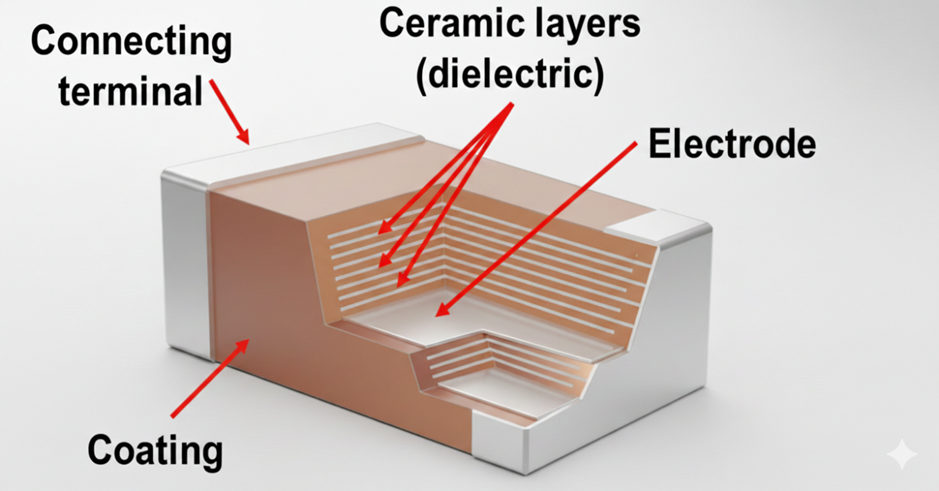
Structure of an MLCC
- Ceramic dielectric layers – These act as the insulating material between conductive plates. The dielectric material determines key characteristics such as capacitance stability, temperature performance, and voltage behaviour.
- Internal metal electrodes – Thin conductive layers are alternated between ceramic layers and connected to the external terminations.
- External terminations – These provide an electrical connection to the PCB and are typically plated to support soldering.
The structure can be visualised as many tiny capacitors stacked in parallel within a single body. Each ceramic layer and electrode pair contributes to the component's total capacitance.
Why the Multilayer Design Increases Capacitance
Capacitance is proportional to the surface area of the electrodes and inversely proportional to the distance between them. By stacking dozens or even hundreds of extremely thin ceramic layers, manufacturers significantly increase the effective electrode area while keeping the overall component size very small.
This multilayer construction allows MLCCs to achieve:
- High capacitance in compact SMD packages
- Improved high-frequency performance
- Lower equivalent series resistance (ESR) compared to many other capacitor types
As a result, MLCCs are well-suited to modern electronics where board space is limited, but performance requirements are demanding.
Common PCB Applications
On printed circuit boards, MLCCs are commonly used for:
- Decoupling & Bypassing: Stabilizing voltage supply to sensitive Integrated Circuits (ICs).
- Noise Filtering: Suppressing electromagnetic interference (EMI) to ensure clean signal paths.
- Timing & Signal Coupling: Maintaining signal integrity in high-speed communication circuits.
- Power Management: Assisting in voltage regulation, smoothing, and transient response.
Your Strategic Partner in Australia & New Zealand
Active Components partners with world-class manufacturers to provide high-reliability MLCCs across the ANZ region. However, we believe a supplier should provide more than just a part number.
We act as a technical extension of your team. When you share your Bill of Materials (BOM) with us, we don't just quote prices; we perform a BOM Optimisation to identify:
- Supply Chain Risks: Highlighting parts at risk of obsolescence or extended lead times.
- Cost Efficiencies: Identifying over-specified components where a more cost-effective alternative exists.
- Drop-in Replacements: Recommending pin-to-pin compatible alternatives to keep your production line moving during global shortages.
Let’s Talk About Your Project - Whether you are in the prototyping phase or scaling for mass production, our team is ready to consult on your component requirements and supply chain strategy.
Key MLCC Specifications Engineers Should Understand
Selecting the right multilayer ceramic capacitor requires more than simply matching capacitance values. Performance, stability, and long-term reliability all depend on understanding several critical specifications.
Below are the key parameters engineers and procurement teams should carefully evaluate when sourcing MLCCs for industrial, automotive, and electronic applications across the ANZ market.
Capacitance and Voltage Rating
Capacitance (measured in pF, nF, or µF) determines how much charge the capacitor can store. In practical PCB design, this directly affects filtering performance, ripple suppression, and signal stability.
However, capacitance should never be considered in isolation.
Voltage rating defines the maximum DC voltage the capacitor can safely withstand. In practical design, engineers commonly operate the capacitor at 50–70% of its rated voltage to reduce stress and improve long-term reliability.
This is particularly important in industrial control boards and power management circuits commonly used in New Zealand and Australian manufacturing environments, where voltage fluctuations may occur.
Dielectric Types: C0G, X7R, and X5R
The dielectric material significantly influences stability, temperature performance, and capacitance behaviour under DC bias.
- C0G (NP0) - Offers excellent temperature stability and very low capacitance drift. Ideal for precision timing and RF circuits.
- X7R - Provides a good balance between capacitance, value and stability. Widely used in general-purpose applications, including industrial control and telecommunications equipment.
- X5R - Similar to X7R but with a narrower temperature range. Often selected where size constraints are critical.
For example, X7R capacitors are commonly used in industrial control boards and power supply filtering due to their stable performance across varying operating conditions.
Temperature Rating
MLCC performance is influenced by operating temperature. Dielectric classification codes (such as X7R) indicate the allowable temperature range and capacitance variation.
Understanding the thermal environment is essential, particularly in applications such as renewable energy systems or automotive electronics operating in harsh outdoor conditions across Australia.
Package Sizes (1808, 1812, 2211, 2220)
Safety-certified MLCCs are typically manufactured in larger surface-mount case sizes, including:
Compared with standard miniature MLCC packages, these formats provide increased creepage distance and stronger mechanical structure. This is essential for safety capacitor applications such as X1, X2, and Y2 classes, where insulation reliability and surge withstand capability are critical.
- The larger case geometry supports:
- Higher rated voltage capability
- Improved insulation performance
- Greater reliability under high humidity and electrical stress
- Reduced risk of PCB flex cracking
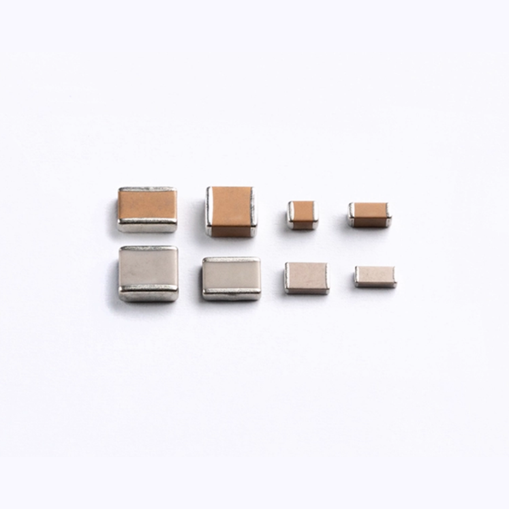
For example, the FK/FH Safety Certified Capacitor series from PDC adopts these larger case dimensions to provide enhanced surge and lightning immunity in modems, facsimile machines, and other AC line-connected electronic equipment.
Tolerance
Tolerance indicates the maximum deviation of the actual capacitance from its nominal value. Common tolerance options include:
- ±1% (precision circuits)
- ±5%
- ±10%
- ±20% (general decoupling applications)
For noise filtering and decoupling, wider tolerances are typically acceptable. However, timing and signal circuits often require tighter tolerances to maintain accuracy.
Applications of MLCC
Multilayer ceramic capacitors are used across virtually every electronics sector. Demand is largely driven by industrial, infrastructure, automotive, and energy-related applications where reliability and long-term stability are critical. Below are some of the key industries where MLCCs play an essential role.
Automotive Electronics and the Growing EV Sector
Australia’s growing adoption of electric vehicles and advanced automotive systems has driven higher demand for reliable passive components. Modern vehicles, including EVs and hybrid platforms, rely heavily on electronic control units (ECUs), battery management systems (BMS), infotainment systems, and safety modules.
MLCCs are commonly used for:
- Power rail decoupling
- Signal filtering in sensor systems
- High-frequency noise suppression
- Voltage stabilisation in control modules
Automotive-grade MLCCs are designed to withstand vibration, temperature extremes, and long operational lifecycles, making correct specifications particularly important in this sector.
Renewable Energy Systems
Renewable energy infrastructure continues to expand globally, including solar installations and distributed energy systems. MLCCs are widely used in:
- Solar inverters
- Power conversion modules
- Energy storage systems
- Grid interface control boards
In large-scale solar environments and off-grid or remote power applications, capacitors must operate reliably under fluctuating temperatures and varying electrical loads. Stable dielectric performance and appropriate voltage derating are especially important under these operating conditions.
Industrial Automation
Manufacturing, food processing, and water treatment across the ANZ region rely on automated control systems and programmable logic controllers (PLCs). Within industrial automation systems, MLCCs are typically used for:
- Decoupling microcontrollers and processors
- Noise suppression in motor drive circuits
- Signal conditioning
- Power smoothing in switching regulators
Because these systems often operate continuously, component reliability and consistent supply availability are major considerations for engineers and procurement teams.
Telecommunications Infrastructure
Telecommunications networks, data centres, and communication equipment require stable signal integrity and minimal electrical noise. MLCCs are essential in:
- RF modules
- Base station electronics
- Network switches and routers
- Signal filtering and timing circuits
With ongoing infrastructure upgrades and 5G expansion across Australia and New Zealand, demand for compact, high-frequency capacitors remains strong.
Medical Devices
Medical equipment manufacturing and assembly in the region also depends on high-quality passive components. From diagnostic equipment to monitoring systems, MLCCs are used to maintain signal stability and regulate power in sensitive electronic assemblies.
In medical applications, factors such as capacitance stability, low leakage, and long-term reliability are critical to maintaining consistent device performance.
Need Support with MLCC Selection?
Multilayer ceramic capacitors remain fundamental to reliable electronic design. Selecting the right specification, from dielectric type to voltage derating and safety classification, is critical to long-term performance.
If you need support with MLCC selection, cross-referencing, or supply planning, contact Active Components. Our team is ready to assist with your technical and sourcing requirements.
https://www.activecomponents.com/page/contact/contact-us
Frequently Asked Questions
Where to Buy MLCC Capacitors in New Zealand and Australia
If you're looking to purchase MLCC (Multilayer Ceramic Chip Capacitors) in New Zealand or Australia, Active Components is a trusted distributor working with global suppliers such as PDC, delivering high-quality and reliable MLCC solutions across a wide range of industries.
We support engineers, OEMs, contract manufacturers, and procurement teams with consistent supply and responsive local service.
Does Active Components provide customised solutions for electronic components?
Yes. At Active Components, we go beyond standard component distribution. Our custom solutions service supports customers who require:
- Alternative or equivalent part recommendations.
- Assistance in sourcing hard-to-find or specialised components.
- Supply planning aligned with production schedules and forecast requirements.
We work closely with engineers and procurement teams to ensure component reliability, supply continuity, and long-term project support. In addition, we work closely with businesses to identify challenges within their electronic component selection, sourcing, or supply chain processes. Rather than simply supplying parts, we help uncover the root cause of performance, cost, or availability issues and develop tailored solutions that improve reliability, efficiency, and long-term supply stability.
To see how we’ve supported real-world projects, explore our case studies to see how we deliver tailored solutions.
Do you have warehouse facilities locally?
Yes. Active Components operates warehouse facilities in New Zealand, with additional logistics support from our Hong Kong warehouse.
We hold stock locally and dispatch directly within New Zealand to ensure fast and reliable delivery.
In addition, we work closely with customers on tailored inventory planning and scheduled supply arrangements from our global partners. This allows customers to:
- Secure production-critical components in advance
- Reduce exposure to global supply chain disruptions
- Avoid excess inventory and holding costs
- Maintain consistent and predictable delivery schedules
By combining local warehousing with strategic supply planning, we help customers improve continuity, reduce risk, and support smoother production operations.
